![[Made in China EP.2] The Resource Trap: EV Graveyards and the Global Hunt… The Price of “Fast Fish” Economics](https://truestworld.com/wp-content/uploads/2026/01/china-product-green.webp "[Made in China EP.2] The Resource Trap: EV Graveyards and the Global Hunt… The Price of \"Fast Fish\" Economics 1 Truest World")
Series Title: Made in China: From Unrivaled Factory to the Chip War Dead End
Article Title: [Made in China EP.2] The Resource Trap: EV Graveyards and the Global Hunt… The Price of “Fast Fish” Economics
In EP.1, we witnessed the might of the “World’s Factory” that no nation has been able to overthrow. But have you ever wondered… what is being swept under the rug of the fastest-moving conveyor belt on Earth?
Welcome to EP.2 of the Made in China trilogy. Today, we take you to the “Dark Side” of an economic model that prioritizes Volume above all else. A model that has created scenes the world watches in disbelief: Mountains of abandoned electric vehicles and a cross-continental hunt for resources to feed an insatiable industrial beast.
1. EV Graveyards: When “Subsidies” Create “Waste”
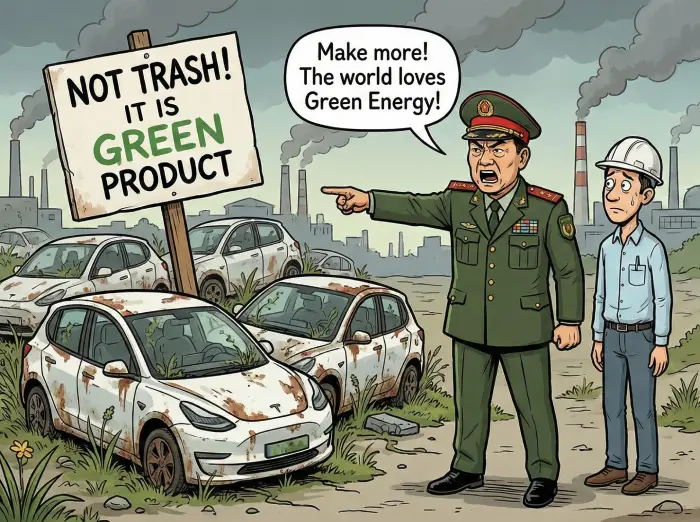
Drone footage flying over fields in Hangzhou reveals thousands of electric vehicles (EVs) parked, rotting under the sun and rain, with weeds growing through their chassis. These aren’t broken cars; they are brand-new vehicles “manufactured to be abandoned.”
This is the side effect of Supply-side Economics, where the Chinese government injected massive subsidies into carmakers to accelerate a new industry.
- The Subsidy Game: Many companies churned out cars simply to claim government cash and inflate sales figures, with zero regard for actual market demand.
- Failed Car Sharing: Huge fleets came from ride-sharing startups founded solely to harvest these subsidies, only to go bust and leave the cars as monuments to waste.
In China’s eyes, this is a “Tuition Fee” they are willing to pay to ensure a few strong survivors (like BYD) dominate the world. But to the rest of the world, it is a colossal waste of resources and an environmental time bomb.
2. Ghost Cities: Built for GDP, Not for People
It’s not just cars; entire “cities” are being overproduced. China’s economic model relies heavily on real estate (accounting for up to 30% of its GDP). The easiest way to pump up GDP numbers is simple: Build. Local governments sell land -> Developers borrow to build condos -> GDP grows.
The result? “Ghost Cities” filled with skyscrapers, eight-lane highways, and shopping malls, but zero inhabitants because prices are disconnected from real incomes. This is a massive ticking time bomb (like the Evergrande crisis), reflecting that the World’s Factory is producing things the world (and its own people) doesn’t actually need.
3. The Global Hunt: The New Colonialism
When domestic factories run at full steam, domestic resources aren’t enough. China must “hunt.” Through the Belt and Road Initiative (BRI), China builds roads, ports, and dams for developing nations in Africa and South America… not for charity, but in exchange for “mining rights.”
- Cobalt in Congo: Essential for almost all EV batteries, largely controlled by Chinese firms.
- Lithium in South America: Major mines are being snapped up by Chinese stakeholders.
While the world celebrates “Green Energy,” China is quietly playing a game of Upstream Monopoly. They are ensuring that no matter what energy source the world switches to, China will always be the one selling the raw materials.
4. The Shadow Guardians: Hypocrisy at the Border
The hunger for resources doesn’t just cost money; it costs integrity. China has long championed a foreign policy of “Non-Interference” (not meddling in other countries’ internal affairs). But when its resource lifelines are threatened, this principle vanishes like smoke.
A prime example is Myanmar. To secure oil and gas pipelines running to the Indian Ocean (bypassing the US-dominated Malacca Strait), China needs stability in a volatile land.
- Boots on the Ground: Reports suggest China has deployed private security contractors and armed drones into Myanmar’s territory to protect these strategic pipelines from ethnic rebel attacks.
- Funding the buffer: Paradoxically, Beijing also maintains ties with powerful ethnic armies (like the UWSA) along the border to create a “security buffer” for its assets.
This reveals a stark reality: For the World’s Factory, sovereignty is optional when supply chains are at risk. The Dragon speaks of peace, but its claws are deeply embedded in its neighbors’ soil to ensure the oil keeps flowing.
👉 [Deep Dive: When the Dragon Speaks of Peace but Moves in Shadows – Read full analysis on China’s Double Standard on Non-Intervention here.]
Conclusion: The Trap of Their Own Making
The model of “Mass Produce, Subsidize, and Hunt for Resources” has made China grow faster than any nation in history. But it comes at the cost of environmental fragility and a massive debt bubble.
Crucially, no matter how many mineral resources China hoards, there is one tiny grain of sand they still cannot dig up and struggle to manufacture. And that single weakness is about to determine the loser of the next war.
In the final episode, we dissect the Dragon’s only fatal flaw. 👉 [Read Next – EP.3: The Silicon War… When a Fingernail-Sized Chip Becomes the Wall the Chinese Army Cannot Climb] (Coming Soon)
Views: 1