
Tag: Made in China

  • [Made in China EP.3] The Silicon War: When a Fingernail-Sized Chip Becomes the Wall the Chinese Army Cannot Climb
    [Made in China EP.3] The Silicon War: When a Fingernail-Sized Chip Becomes the Wall the Chinese Army Cannot Climb

    Series Title: Made in China: From Unrivaled Factory to the Chip War Dead End

    Article Title: [Made in China EP.3] The Silicon War: When a Fingernail-Sized Chip Becomes the Wall the Chinese Army Cannot Climb

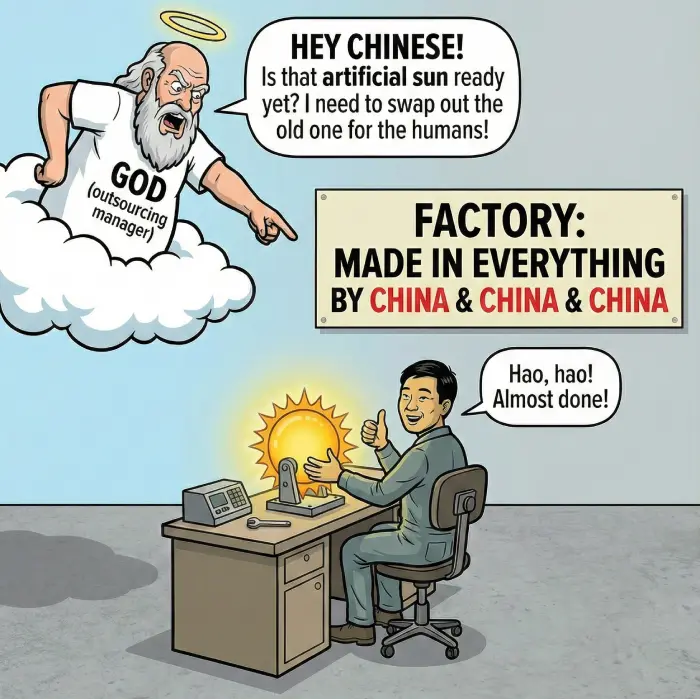
    hey chinese hurry up Truest World

    We have reached the finale of the Made in China trilogy. In EP.1, we saw China dominate the world with an uncopyable factory model. In EP.2, we watched them scour the globe for resources to feed those factories.
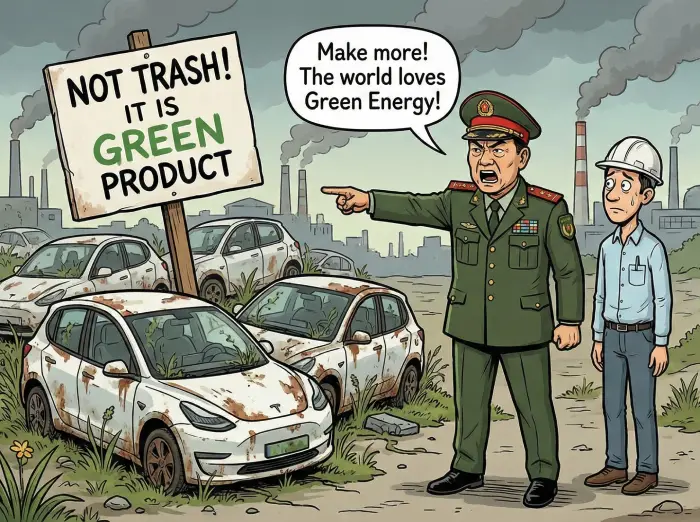
    china product green Truest World

    But in EP.3, we confront a bitter irony: A nation capable of building an “Artificial Sun” and landing rovers on the dark side of the moon cannot manufacture a tiny, fingernail-sized square called an “Advanced Semiconductor.”

    And this tiny square is the “Kill Switch” currently held in the hands of the United States.

    1. The Great Divide: Master of the Low-End, Failure at the High-End

    First, let’s be clear: China knows how to make chips.

    • Legacy Chips (28nm and above): These are the chips found in cars, washing machines, and TVs. China is excellent at producing them and is on track to flood the global market with cheap supply.
    • Advanced Chips (Below 7nm): These are the “brains” of AI, Supercomputers, and the latest iPhones. Here, China is dead in the water.

    Why? Because manufacturing these chips requires a machine called EUV Lithography (made by ASML), arguably the most complex machine in human history. The US has strictly forbidden its sale to China.

    2. Big but Blind: An Army with Bad Eyesight

    This isn’t just about iPhones; it’s about War. Modern weaponry isn’t measured by the size of the explosion, but by “Intelligence.”

    • Hypersonic Missiles: Require high-speed processing chips to maneuver.
    • J-20 Fighter Jets: Need precise radar chips to detect enemies.
    • Smart Drones: Rely on AI chips to identify targets.

    Without advanced chips, the Chinese military might have more ships than the US (Quantity), but their guidance systems could be “dumber” and “slower” (Quality) in actual combat. This is a risk Beijing cannot accept.

    3. The Desperate Chase: The Dragon’s Last Bet

    Strangled by sanctions, China is making a desperate “Manhattan Project” style gamble.

    • Unlimited Budget: The government’s “Big Fund” is pouring trillions of yuan into building domestic chip-making equipment (even if it lags 10 years behind the West).
    • Headhunting & Poaching: China is hiring top engineers from Taiwan and South Korea with astronomical salaries, hoping to shortcut the R&D process.
    • Secret Workarounds: They are experimenting with “Chiplet” technology—stacking multiple older chips together to mimic the performance of a newer one—just to survive the blockade.

    Trilogy Conclusion: The Giant with a Fatal Flaw

    The Made in China series ends with this crystal-clear image: China is a giant with a muscular body (The Factory – EP.1) and excellent blood circulation (Resources – EP.2)… but the “Brain” (Chips – EP.3) is still held hostage by its rival.

    As long as China cannot manufacture this “Brain” domestically, its dream of becoming the world’s undisputed superpower remains a fragile illusion. This explains why Taiwan (home to TSMC, the world’s #1 chipmaker) is the most dangerous place on Earth… it holds the final puzzle piece the Dragon is missing.

    Views: 0
  • [Made in China EP.2] The Resource Trap: EV Graveyards and the Global Hunt… The Price of “Fast Fish” Economics

    [Made in China EP.2] The Resource Trap: EV Graveyards and the Global Hunt… The Price of “Fast Fish” Economics

    Series Title: Made in China: From Unrivaled Factory to the Chip War Dead End

    Article Title: [Made in China EP.2] The Resource Trap: EV Graveyards and the Global Hunt… The Price of “Fast Fish” Economics

    In EP.1, we witnessed the might of the “World’s Factory” that no nation has been able to overthrow. But have you ever wondered… what is being swept under the rug of the fastest-moving conveyor belt on Earth?

    Welcome to EP.2 of the Made in China trilogy. Today, we take you to the “Dark Side” of an economic model that prioritizes Volume above all else. A model that has created scenes the world watches in disbelief: Mountains of abandoned electric vehicles and a cross-continental hunt for resources to feed an insatiable industrial beast.

    1. EV Graveyards: When “Subsidies” Create “Waste”

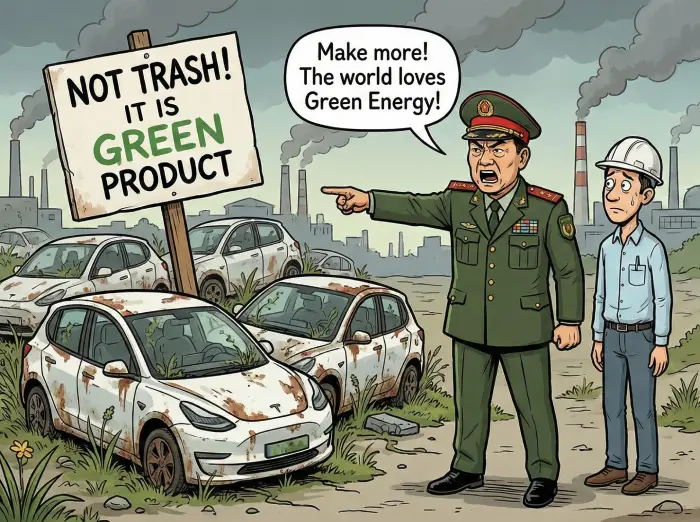
    Drone footage flying over fields in Hangzhou reveals thousands of electric vehicles (EVs) parked, rotting under the sun and rain, with weeds growing through their chassis. These aren’t broken cars; they are brand-new vehicles “manufactured to be abandoned.”

    This is the side effect of Supply-side Economics, where the Chinese government injected massive subsidies into carmakers to accelerate a new industry.

    • The Subsidy Game: Many companies churned out cars simply to claim government cash and inflate sales figures, with zero regard for actual market demand.
    • Failed Car Sharing: Huge fleets came from ride-sharing startups founded solely to harvest these subsidies, only to go bust and leave the cars as monuments to waste.

    In China’s eyes, this is a “Tuition Fee” they are willing to pay to ensure a few strong survivors (like BYD) dominate the world. But to the rest of the world, it is a colossal waste of resources and an environmental time bomb.

    2. Ghost Cities: Built for GDP, Not for People

    It’s not just cars; entire “cities” are being overproduced. China’s economic model relies heavily on real estate (accounting for up to 30% of its GDP). The easiest way to pump up GDP numbers is simple: Build. Local governments sell land -> Developers borrow to build condos -> GDP grows.

    The result? “Ghost Cities” filled with skyscrapers, eight-lane highways, and shopping malls, but zero inhabitants because prices are disconnected from real incomes. This is a massive ticking time bomb (like the Evergrande crisis), reflecting that the World’s Factory is producing things the world (and its own people) doesn’t actually need.

    3. The Global Hunt: The New Colonialism

    When domestic factories run at full steam, domestic resources aren’t enough. China must “hunt.” Through the Belt and Road Initiative (BRI), China builds roads, ports, and dams for developing nations in Africa and South America… not for charity, but in exchange for “mining rights.”

    • Cobalt in Congo: Essential for almost all EV batteries, largely controlled by Chinese firms.
    • Lithium in South America: Major mines are being snapped up by Chinese stakeholders.

    While the world celebrates “Green Energy,” China is quietly playing a game of Upstream Monopoly. They are ensuring that no matter what energy source the world switches to, China will always be the one selling the raw materials.

    4. The Shadow Guardians: Hypocrisy at the Border

    The hunger for resources doesn’t just cost money; it costs integrity. China has long championed a foreign policy of “Non-Interference” (not meddling in other countries’ internal affairs). But when its resource lifelines are threatened, this principle vanishes like smoke.

    A prime example is Myanmar. To secure oil and gas pipelines running to the Indian Ocean (bypassing the US-dominated Malacca Strait), China needs stability in a volatile land.

    • Boots on the Ground: Reports suggest China has deployed private security contractors and armed drones into Myanmar’s territory to protect these strategic pipelines from ethnic rebel attacks.
    • Funding the buffer: Paradoxically, Beijing also maintains ties with powerful ethnic armies (like the UWSA) along the border to create a “security buffer” for its assets.

    This reveals a stark reality: For the World’s Factory, sovereignty is optional when supply chains are at risk. The Dragon speaks of peace, but its claws are deeply embedded in its neighbors’ soil to ensure the oil keeps flowing.

    👉 [Deep Dive: When the Dragon Speaks of Peace but Moves in Shadows – Read full analysis on China’s Double Standard on Non-Intervention here.]

    china product green 1 Truest World

    Conclusion: The Trap of Their Own Making

    The model of “Mass Produce, Subsidize, and Hunt for Resources” has made China grow faster than any nation in history. But it comes at the cost of environmental fragility and a massive debt bubble.

    Crucially, no matter how many mineral resources China hoards, there is one tiny grain of sand they still cannot dig up and struggle to manufacture. And that single weakness is about to determine the loser of the next war.

    In the final episode, we dissect the Dragon’s only fatal flaw. 👉 [Read Next – EP.3: The Silicon War… When a Fingernail-Sized Chip Becomes the Wall the Chinese Army Cannot Climb] (Coming Soon)

    Views: 1

  • [Made in China EP.1] The China Paradox: Why the World Knows “How”, But Can’t Copy the “Factory”

    [Made in China EP.1] The China Paradox: Why the World Knows “How”, But Can’t Copy the “Factory”

    Series Title: Made in China: From Unrivaled Factory to the Chip War Dead End

    Article Title: [Made in China EP.1] The China Paradox: Why the World Knows “How”, But Can’t Copy the “Factory”

    For the past decade, we’ve heard the same predictions on repeat: “Manufacturing is moving to Vietnam,” “India is the next China,” or “Rising wages will end China’s reign.”

    But here is the reality TruestWorld wants you to see today: Why haven’t those prophecies fully materialized? Why does Apple still rely heavily on China? Why has the world failed to successfully clone the “China Model”?

    Welcome to the “Made in China” trilogy. In this series, we will dissect the anatomy of this economic superpower through three lenses you might have missed:

    • EP.1: The Uncopyable Factory (Why is the Chinese factory model unbeatable?)
    • EP.2: The Resource Trap (The hidden cost of EV graveyards and the global resource hunt.)
    • EP.3: The Silicon War (The semiconductor dead end—China’s only fatal weakness.)

    Let’s start with EP.1. The answer isn’t “cheap labor” anymore (Chinese factory wages are now often higher than in Thailand or Vietnam). So, what is their secret weapon? Here are the 3 hard truths.

    1. The “50-Kilometer” Rule: The Power of Clustering

    Imagine you are a startup trying to build a simple electric drill.

    • In Shenzhen: You walk out of your office. Five kilometers away, you find a motor factory. Next block, a plastic injection molding plant for the grip. Across the street, a screw supplier. And ten kilometers down the road, a packaging facility. You can finish your prototype in 48 hours.
    • In India or Vietnam: You might have to import the motor from China (2 weeks wait), source plastic from another city (via unpaved roads), and wait for screws from a different state. By the time you assemble one drill, your Chinese competitor has already shipped 100,000 units.
    hey chinese hurry up Truest World

    This is the Supply Chain Cluster—a “buffet-style” ecosystem China spent 30 years building. Other nations might build assembly plants, but they cannot instantly transplant this entire root system of tens of thousands of suppliers.

    2. Infrastructure on Steroids: State Capitalism

    In a typical capitalist economy, the government builds roads after development arrives. In China’s State Capitalism, the government builds them in anticipation.

    China is home to 7 of the world’s top 10 busiest ports. High-speed rails transport goods from deep inland factories to coastal ports overnight. Meanwhile, in competitors like India or some ASEAN nations, business owners still wake up worrying: “Will there be a power outage today?” or “Will the truck get stuck in mud?”

    This stability is a hidden premium that investors are willing to pay for. It guarantees that goods are delivered on time, every time.

    3. The “Scale” Game: Killing with Volume

    China doesn’t compete on “price per unit” in small batches; it competes on massive Volume. When a Chinese factory receives an order, they aren’t just producing 100,000 units. They are ready to churn out 100 million units to feed their own domestic market of 1.4 billion people, plus the rest of the world.

    When production hits this scale, the cost per unit (Economy of Scale) drops to rock bottom. New competitors in other countries, just starting out, simply cannot compete with these prices. It is an invisible wall that keeps newcomers out.

    Conclusion: The Irreplaceable Factory

    “Decoupling” from China is possible only on the surface (like final assembly stages) to avoid tariffs. But the “core”—the upstream supply chain of raw materials, chemicals, and electronic components—remains shackled to the Chinese factory floor.

    However… beneath this industrial grandeur lies a massive, hidden cost. From reckless resource consumption to overproduction that creates mountains of waste.

    In the next episode, we will take you to the “Dark Side” of this accelerated growth. 👉 [Read Next – EP.2: EV Graveyards and Ghost Cities: When China Overproduces and Hunts for Global Resources] (Coming Soon)

    Views: 0