
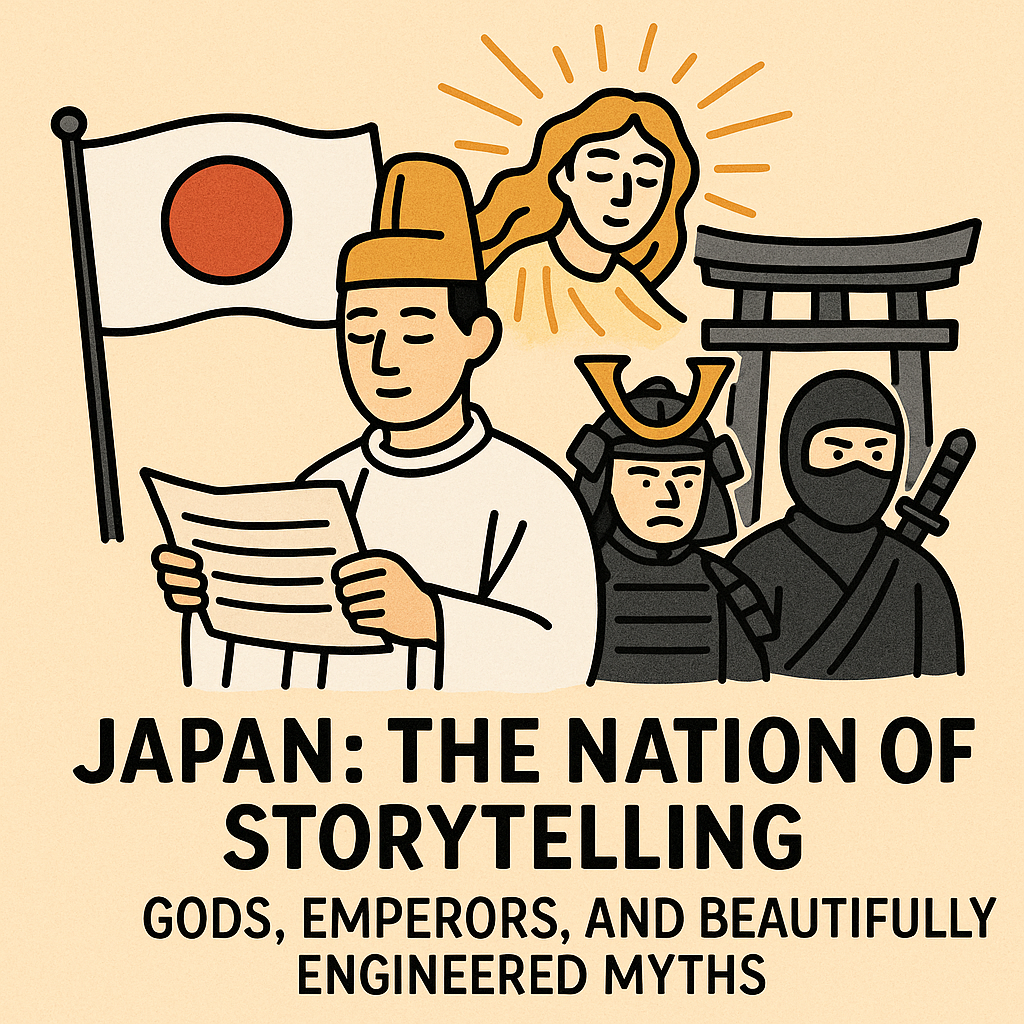
Gods, Emperors, and Beautifully Engineered Myths
Most countries build stories.
But few tell them so elegantly, so convincingly, and with such lasting effect… as Japan. 🎭✨
From gods who created the world, to an unbroken royal bloodline stretching back over 2,600 years, Japan presents a history that feels both sacred and strangely unquestioned.
But what if the stories were just… well-told stories?
Let’s peel back the layers. 🧠🔍
👑 The World’s Oldest Royal Family… or Just the Best-Written?
Japan often claims to have the oldest continuous monarchy in the world — starting with Emperor Jimmu in 660 BCE, supposedly a direct descendant of the sun goddess Amaterasu. 🌞
But here’s the twist:
📜 Historical records and archaeology only begin to confirm emperors from around the 6th century CE (Emperor Kinmei, the 29th ruler).
Before that? It’s all written in Kojiki and Nihon Shoki — official chronicles composed after the fact, commissioned by the imperial court itself. 🎨
“It’s not a lie. It’s just a very good origin story.” 😌
So, while the first 28 emperors are part of the official lineage, they have no external or archaeological proof — just Japanese text claiming they existed.
🛕 From Heaven They Came: Gods as Political Branding
The Kojiki isn’t just myth.
It’s political marketing — 8th-century style.
The creation myth tells of Izanagi and Izanami forming the Japanese islands, then birthing gods — including Amaterasu, goddess of the sun 🌞, who sends her descendants to rule Japan.
This divine connection wasn’t a bedtime story.
It was a legal argument for imperial rule. 📜👑
By tracing their roots to heaven, emperors didn’t need armies to justify their power — they had sacred blood.
Gods don’t get elected. They just shine. ✨
🥷 The Art of Belief: From Ninja to Samurai
Let’s fast-forward.
Today’s world believes in:
- Superpowered ninjas 🥷
- Noble samurai who lived by the sword and honor ⚔️
- Cherry blossoms, Zen temples, and spiritual serenity 🌸🧘♂️
But the truth is:
- Most ninjas were farmers doing espionage.
- Samurai often acted more like gang lords than bushido saints.
- And ancient Japan had its fair share of political chaos, cruelty, and clumsy succession wars.
But when you control the narrative — and nobody’s around to challenge it — fiction becomes folklore. And folklore becomes… export. 📦🌏
🧳 An Island with No One to Argue
Why has Japan been so successful in shaping its own mythos?
- 🌊 It’s an island — outsiders couldn’t fact-check much for centuries.
- ✍️ The imperial court wrote and preserved the national history.
- 🔥 There was no regime change — unlike China, France, or Cambodia — meaning no one ever rewrote the books from a different perspective.
So while other countries had their legends challenged or debunked, Japan’s were refined and exported.
Especially in the post-WWII era, where anime, films, and pop culture became its most powerful soft power weapons. 🎌📺🍣
🤯 What If All This Was Just… a Masterclass in Storytelling?
Maybe Japan is the ultimate case of nation-building through narrative.
Not because it lied — but because it knew how to tell a story that people wanted to believe.
It worked internally — giving legitimacy to rule.
It worked globally — making Japan mystical, beautiful, and mysterious.
The most powerful myths… are the ones no one dares to question. 🧘♀️💭

✨ Final Thought
Just because a story is old doesn’t mean it’s true.
But if it’s elegant enough, told often enough, and backed by silence — it doesn’t need to be.
And in a world where attention is the new gold, Japan may be the wealthiest empire of them all. 💰🎎
Views: 3