For decades, the world has been hypnotized by the propaganda that “the dragon is going to rule the world.” A massive military, cutting-edge technology, and on-paper weapon specs have had Western nations scrambling to approve defense budgets on loop.
But if we peel back that intimidating facade and look deep into the core… we might find the darkly comedic truth: this dragon might just be a hollow “paper tiger,” terrified of its own shadow.
1. God-Tier Specs on Paper vs. The Unhidden Truth
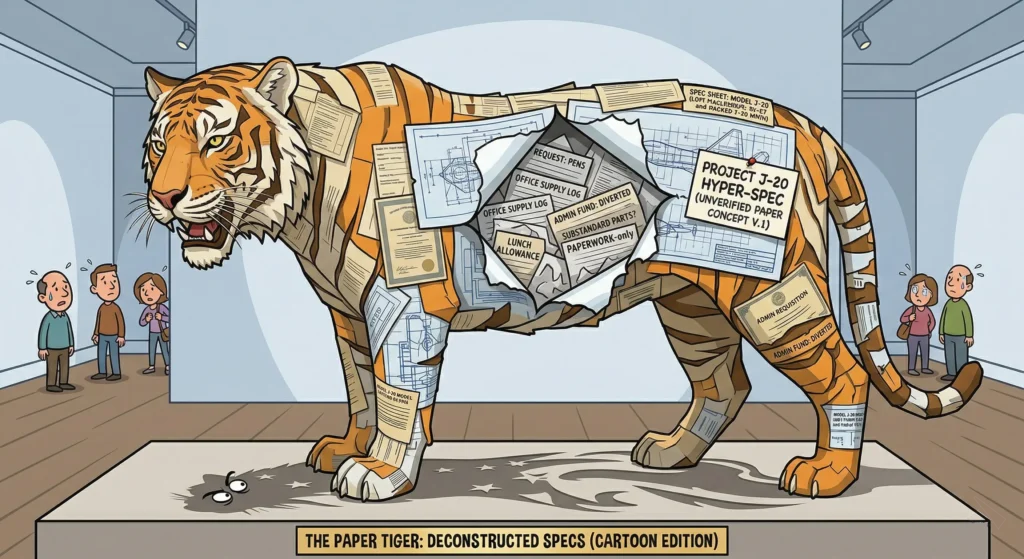
They claim to have the 5th-generation J-20 stealth fighter ready to dominate the skies. But behind this grandeur is reverse engineering (or simply put, “copying”)—cobbling together scrapped Russian project designs and mashing them up with data hacked from the West. The result? A bulky stealth aircraft that might only be invisible when flying straight ahead.
What’s more biting are the heavy rumors about the project head who recently vanished from history—not because a plane crashed, but due to a massive purge of long-rotting corruption within the military. Falsified specs, substandard parts… Doesn’t this sound exactly like the Qing Dynasty era when naval funds were embezzled to build a summer palace?
This aligns perfectly with a recent TruestWorld exclusive interview with ‘Sam,’ a former Chinese Armed Police officer. He confirmed that the military rots from top to bottom, with research funds and even vehicle fuel regularly sold off by corrupt commanders. Read the full exposé: [Exclusive Interview: China Can Never Defeat Taiwan]
2. Buffet History… Claim It All If It Looks Good
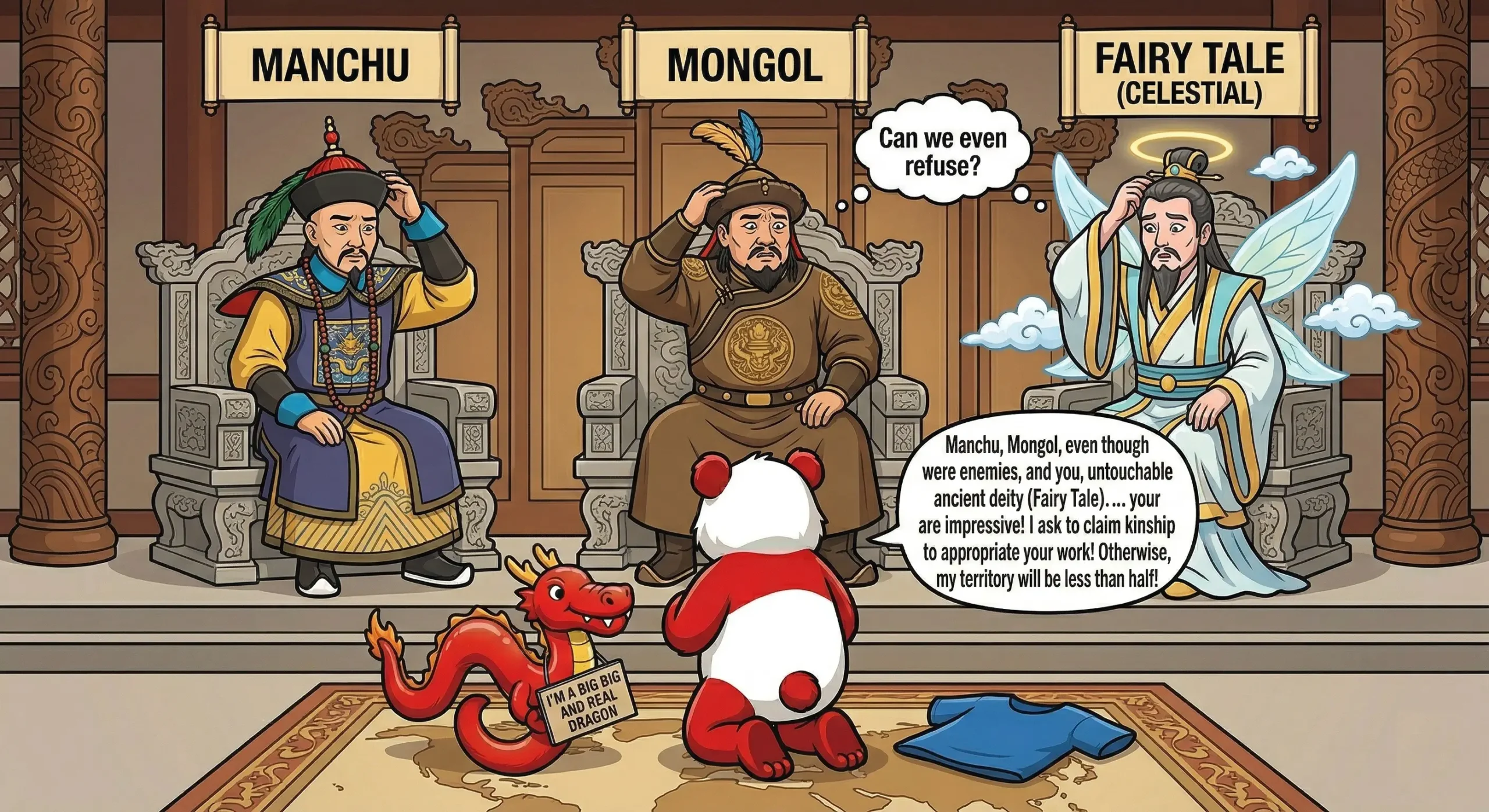
To stoke nationalism and maintain a massive national map, they have to play jokes with their own history. Han ancestors who were historically oppressed by Mongols and Manchus—forced to wear queues—are conveniently forgotten. Instead, they suddenly claim kinship, sweeping up the territorial conquests of the Yuan and Qing dynasties as their immediate “national legitimacy.”
Without these shameless claims, their map would be much smaller than it is now—not even half of their current territory, in fact.
And please, let’s not even start with the claim that the Chinese people are great, having spread all over the world. Are we really comparing this to the Mongols, who actively conquered the known world, or the British and other colonial empires that expanded across the globe? No, we are not doing that. This is the tragic story of making one’s own country so impoverished and desolate that the population had to flee for their lives, often forced into indentured labor and coolie jobs globally. To then claim their success, generations later, when their wealth was forged through education, foreign resources, and the melting pot of other nations’ systems, is simply ungrateful. Don’t be ungrateful, child. These are not yours to claim.
Oh, and while we’re at it, don’t even think about claiming Malaysia or Singapore as “Chinese” or belonging to China just because a large number of your migrants settled there. By that absurd logic, Africa—as the cradle of humankind—could just go ahead and claim the entire planet.
Because without these shameless claims, their hold on territories like Tibet, Xinjiang, or even their excuses regarding Taiwan, would carry zero weight on the world stage.
🔥 Related Reading: [The Real Battlefield: Why Beijing Relies on Cognitive Warfare to Break Taiwan Without Firing a Shot]
3. The Neighborhood Bully Who Has Never Seen the Battlefield
The most uncomfortable truth is that this military has “zero actual combat experience” in modern warfare. Their greatest feats are buzzing neighbors’ airspace to intimidate them, firing water cannons at fishing boats, and brawling with clubs at the Indian border.
The high-tech weapons mass-produced by the dozens have never faced the pressure test of a real battlefield fraught with massive variables. The specs reported to the top as invincible might end up like a fish out of water when facing the real deal.
4. When Neighbors Wake Up, and the Nightmare Begins
The attempts to act tough no longer scare the world; instead, they have awakened the beasts next door. A once-slumbering Japan is tearing up restrictions, upgrading defense budgets, and retrofitting warships into aircraft carriers. India is rapidly stockpiling weapons fueled by deep-seated resentment. ASEAN nations like the Philippines and Vietnam are starting to push back and bringing in other superpowers for balance.
If they misstep and act overconfident enough to open a multi-front war, they will find themselves surrounded and ganged up on, no different from the “Century of Humiliation” of the past.
Conclusion:
A government that spends more of its budget on “controlling its own people” than on national defense knows full well that its most terrifying enemy isn’t beyond its borders, but inside its own house. If its next aggressive decision ends in defeat, this dragon won’t just lose face—it will be left behind by the world, stepping into a “Void Century” from which it may never recover.
Views: 0
![[Made in China EP.1] The China Paradox: Why the World Knows “How”, But Can’t Copy the “Factory”](https://truestworld.com/wp-content/uploads/2026/01/god-cover4.webp "[Made in China EP.1] The China Paradox: Why the World Knows \"How\", But Can't Copy the \"Factory\" 3 Truest World")