
Introduction
China often proclaims itself a guardian of sovereignty and a champion of “non-interference” — a voice of calm in a turbulent world, in contrast to the meddling image of the West. Yet, in practice, its actions across Southeast Asia tell a very different story. 🤔
1. The Sacred Doctrine of Non-Intervention
China’s foreign policy is built on the “Five Principles of Peaceful Coexistence”:
- Respect for territorial integrity and sovereignty
- Mutual non-aggression
- Non-interference in internal affairs
- Equality and mutual benefit
- Peaceful coexistence
These ideals allow China to deflect criticism on issues like Taiwan, Hong Kong, and Xinjiang. But when it comes to its neighbors, these principles often dissolve into political convenience. 🧱💨
2. Case Study: The United Wa State Army (UWSA)
In Myanmar, the United Wa State Army — an armed ethnic militia — controls a self-governed region along the China-Myanmar border.
- 25,000+ well-equipped troops
- Uses Chinese yuan, telecom systems, and language
- Operates weapons factories and its own government structure
While China officially denies direct involvement, evidence points to ongoing military, economic, and diplomatic support behind the scenes. 🛠️🎯
3. From Mountains to Maritime Claims 🌊
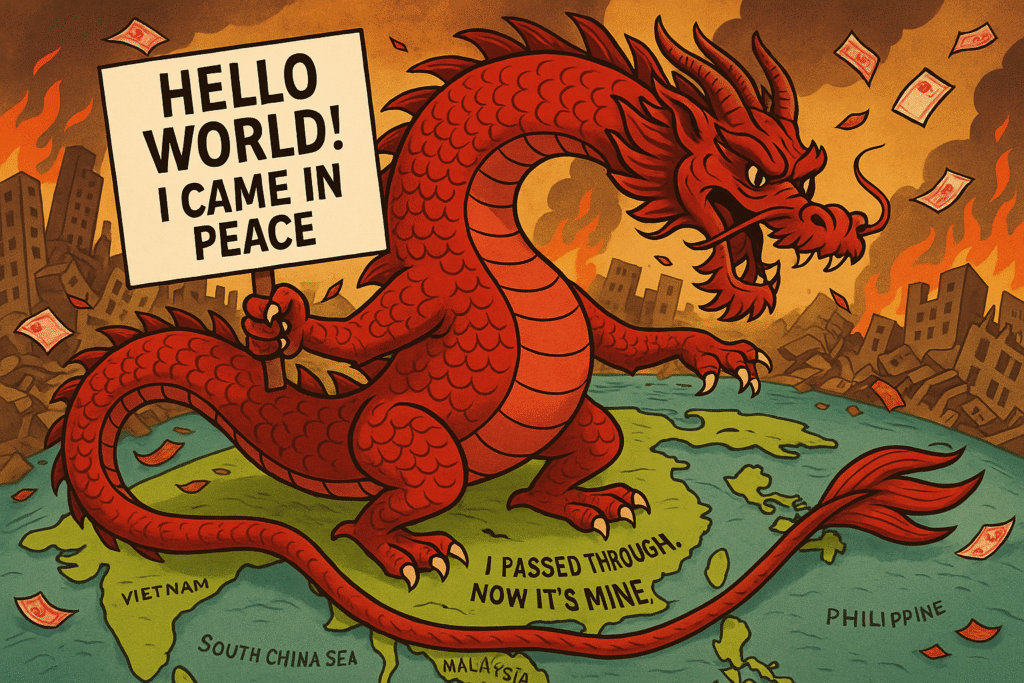
China applies similar logic in the South China Sea:
- Claims based on the historic “Nine-Dash Line”
- Cites ancient maps and tributary missions, not governance or control
- Refuses to accept the 2016 international ruling that invalidated these claims
China turns historical ambiguity into modern hegemony, bypassing international norms — claiming land without conquest. 🗺️🧭
4. “Chinese Blood Never Fades”: Ethnic Nationalism Overseas
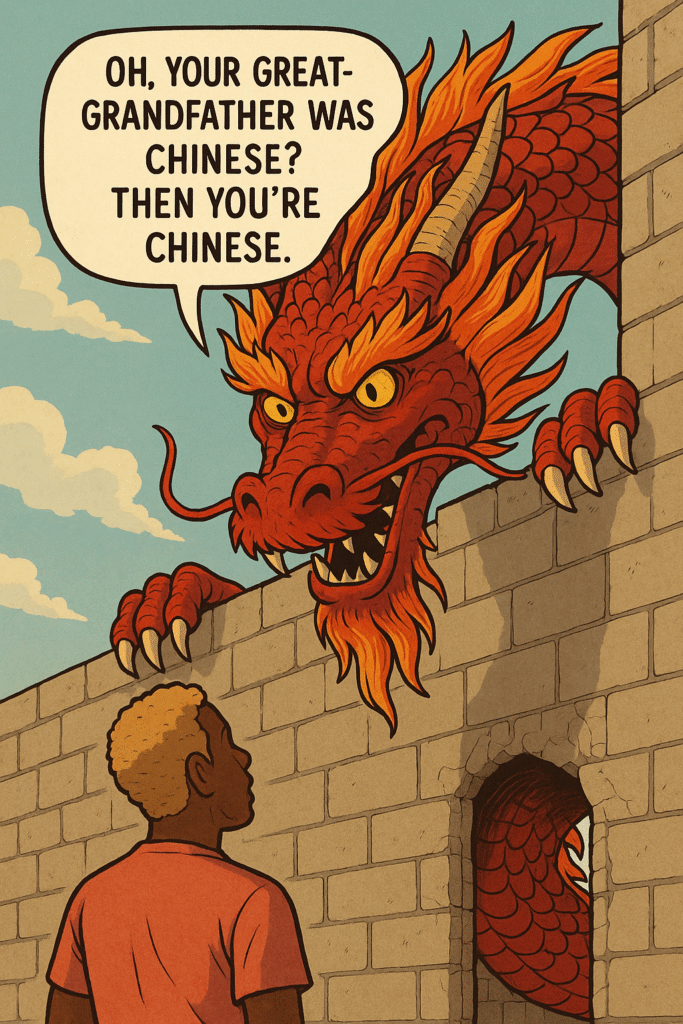
China often considers overseas Chinese communities as extensions of its cultural and political influence — even generations after they’ve naturalized elsewhere.
- Labels them as “Huaqiao” — Chinese citizens abroad
- Uses them as soft-power bridges, or even political leverage
But imagine the reverse: If foreigners in China refused to integrate and insisted on preserving their foreign identity — would the Chinese state welcome that?
China demands cultural acceptance abroad but struggles to return the favor at home. 😐
5. A Betrayal of Laozi: When the Sons of Tao Become Arrogant
Perhaps the deepest irony lies in China’s betrayal of its own ancient wisdom — especially Laozi’s teaching of Taoism.
Tao teaches us to be like water:
- Flow to the lowly places 🌊
- Blend with surroundings 🪷
- Do not cling, do not dominate
Yet modern Chinese nationalism does the opposite — asserting, dominating, demanding recognition wherever it goes. From ports to mountain passes, it acts not like water… but like fire 🔥
The children of Tao have forgotten how to flow.

Conclusion: Principles as a Mask
China’s doctrine of non-intervention has become a diplomatic costume — worn proudly on the global stage, but shed easily when its interests require backdoor influence.
Whether through ethnic militias, maritime maps, or diaspora politics, China redefines sovereignty not as a principle — but as a tool.
The question is no longer “Do people understand China?”
But rather: “Does China still understand itself?” 🤨
Views: 3




![[Made in China EP.3] The Silicon War: When a Fingernail-Sized Chip Becomes the Wall the Chinese Army Cannot Climb](https://truestworld.com/wp-content/uploads/2026/01/made-in-china-ep3.webp "[Made in China EP.3] The Silicon War: When a Fingernail-Sized Chip Becomes the Wall the Chinese Army Cannot Climb 7 Truest World")
![[Made in China EP.2] The Resource Trap: EV Graveyards and the Global Hunt… The Price of “Fast Fish” Economics](https://truestworld.com/wp-content/uploads/2026/01/china-product-green.webp "[Made in China EP.2] The Resource Trap: EV Graveyards and the Global Hunt… The Price of \"Fast Fish\" Economics 12 Truest World")
![[Made in China EP.1] The China Paradox: Why the World Knows “How”, But Can’t Copy the “Factory”](https://truestworld.com/wp-content/uploads/2026/01/god-cover4.webp "[Made in China EP.1] The China Paradox: Why the World Knows \"How\", But Can't Copy the \"Factory\" 13 Truest World")